![{[setting('site_name')]}](https://projxnews.com/uploads/setting/16983847711140531930.webp)
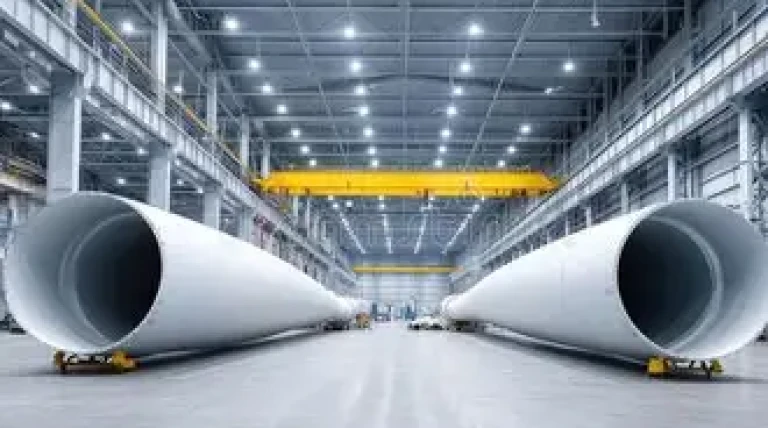
JSW Energy Limited has commissioned its first wind blade manufacturing facility at Halol, Gujarat, strengthening its renewable energy supply chain and advancing its strategy of vertical integration in wind power manufacturing.
The new facility is expected to enhance the company’s control over production schedules, costs, and logistics while reducing reliance on external suppliers. The move forms part of JSW Energy’s broader efforts to build a more resilient and self-sufficient renewable energy ecosystem.
JSW Energy currently operates 3.9 GW of installed wind power capacity and has a substantial pipeline comprising 6.5 GW of locked-in hybrid projects, where wind energy plays a significant role, along with 2.4 GW of dedicated wind projects under development. These projects reinforce the company’s position as a major participant in India’s growing wind energy sector.
The Halol plant has an annual manufacturing capacity of up to 450 wind turbine blades, sufficient to support approximately 600 MW of wind power installations each year. The facility will produce 82-metre blades designed for 4 MW wind turbine generators. In addition, a second blade manufacturing facility at Chitradurga, Karnataka, is nearing commissioning.
According to the company, in-house blade manufacturing will help mitigate supply chain risks, support compliance with domestic content requirements under the Ministry of New and Renewable Energy (MNRE) framework, and improve project economics through lower transportation and procurement costs. The initiative is also expected to reduce exposure to fluctuations in raw material prices for key wind turbine components.
Sharad Mahendra, Joint Managing Director and CEO of JSW Energy, said the commissioning of the Halol facility marks an important milestone in the company’s journey toward creating a more robust and self-reliant renewable energy platform, while enhancing cost efficiency and long-term value creation.
JSW Energy has a total locked-in generation capacity of 32.1 GW, including 13.7 GW of operational assets, 13.8 GW under construction across thermal, hydro, and renewable energy segments, and a development pipeline of 4.6 GW. The company also holds 29.6 GWh of locked-in energy storage capacity through pumped hydro and battery energy storage systems. It aims to achieve 30 GW of generation capacity and 40 GWh of energy storage capacity by 2030 and has committed to achieving net-zero emissions by 2050.
News by Rahul Yelligetti.