![{[setting('site_name')]}](https://projxnews.com/uploads/setting/16983847711140531930.webp)
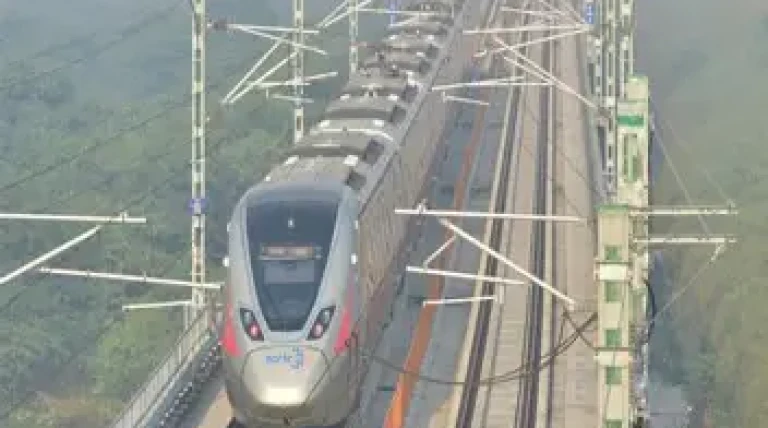

Manohar Lal Khattar on Sunday announced that proposals for two new rapid rail corridors from Sarai Kale Khan railway station are likely to be approved soon, aiming to further strengthen high-speed connectivity across the National Capital Region (NCR).
The announcement came during the inauguration of the Sarai Kale Khan station on the National Capital Region Transport Corporation’s Delhi–Ghaziabad–Meerut Rapid Rail Transit System (RRTS). Khattar said the new corridors would significantly enhance regional mobility and cut travel time between Delhi and neighbouring states.
One proposed corridor will connect Sarai Kale Khan to Karnal in Haryana, spanning roughly 125–130 km and expected to reduce travel time to about 90 minutes. A second corridor is planned from Sarai Kale Khan to Babarpur in Haryana and Neemrana in Rajasthan, further expanding the NCR’s rapid rail network.
The Sarai Kale Khan station, inaugurated virtually by Narendra Modi from Meerut, is set to become a major interchange for the Delhi–Meerut RRTS and future rapid rail lines. Khattar described it as a central hub for the next phase of integrated transport planning in the NCR.
Emphasising the need to expand rapid rail and metro systems, he noted that Delhi’s growth as an economic hub has increased pressure on roads and public transport. He advocated transit-oriented development, promoting housing and commercial projects around metro and rapid rail stations to reduce reliance on private vehicles. He also stressed the importance of strong last-mile connectivity between stations, residential areas, workplaces, and markets.
Khattar said enhanced high-speed rail links would help distribute population growth and economic activity more evenly across Haryana, Uttar Pradesh, and Rajasthan, easing congestion in the national capital.
Highlighting progress in urban transit, he said operational metro networks across India now exceed 1,100 km in 24 cities, compared to 248 km in five cities just over a decade ago. Daily ridership on the Delhi Metro alone has reached about 1.25 crore passengers.
According to the NCRTC, Namo Bharat services on the Delhi–Ghaziabad–Meerut corridor now operate between New Ashok Nagar and Sarai Kale Khan in Delhi, and from Meerut South to Modipuram in Uttar Pradesh. Stations on the extended stretch include Sarai Kale Khan, New Ashok Nagar, Anand Vihar, Sahibabad, Ghaziabad, Guldhar, Duhai, Muradnagar, Modinagar South, Modinagar North, Meerut South, Shatabdi Nagar, Begumpul, and Modipuram.
Additionally, Meerut Metro services have begun operating on the Meerut South–Modipuram section, covering Partapur, Rithani, Bramhapuri, Meerut Central, Bhaisali, MES Colony, Daurli, and Meerut North. Both Namo Bharat and Meerut Metro services on the extended sections commenced operations at 6 pm on February 22, 2026.
News by Rahul Yelligetti.